Showing posts with label okra. Show all posts

Wednesday, September 16, 2015

Fungi (aka New Ways with Okra)

Day 16 of the Vegan Mofo is: What’s your favorite late summer food? Mine just so happens to be okra.

Okra is one of those foods that people generally aren't indifferent to. Either they love it or they hate it. I love it in its many forms - fried, pickled, in a gumbo. This recipe might help those who can't decide. It is like fried okra without the frying, boiled without the sliminess. It doesn't look pretty, and no, it is not fried okra gone awry.

Fungi


One bag of frozen cut okra
1-1/2 c. cornmeal
2 T. butter
Salt and pepper to taste

Boil the okra according to package directions. When done, slowly stir in the cornmeal, and keep stirring until there are not lumps. Add the butter, salt and pepper, cover, and simmer for about 5 minutes. Stir occasionally while it is simmering. Serve. Enjoy!

Friday, December 6, 2013

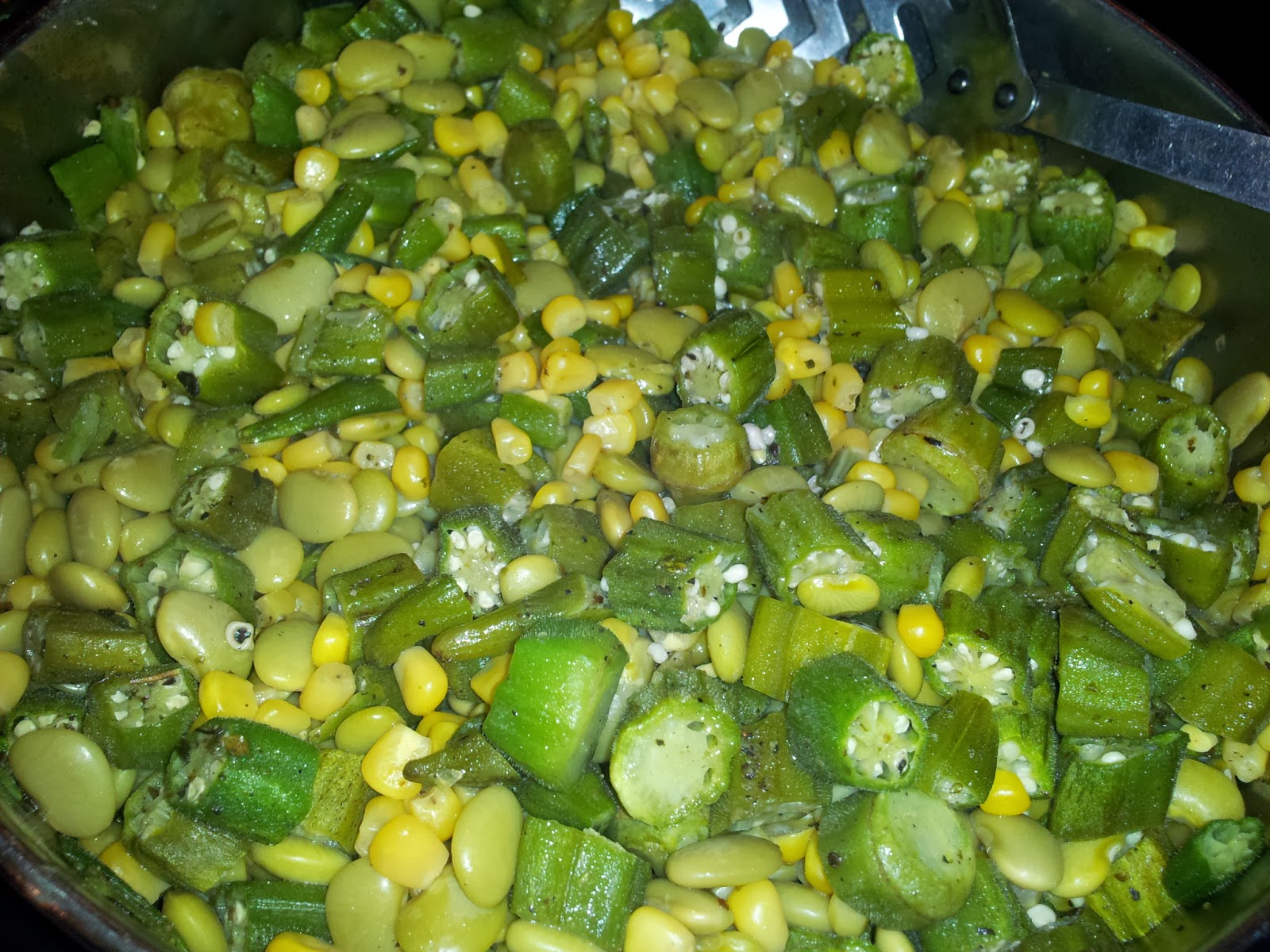
Okra Succotash

My mom said she wanted some succotash for Thanksgiving this year. I made it. With a twist.

Okra Succotash


10 oz frozen lima beans, or one can lima beans, drained
10 oz frozen corn, or one can corn, drained
Frozen okra (as much as you want to add)
2 T. vegan butter
1 t. marjoram
1/2 t. salt
1/4 t. black pepper
1/4 c. vegetable broth

Thaw the frozen okra under warm running water. Add to a frying pan with the butter and marjoram, and stir until okra is heated. Add the limas and corn, along with the salt, pepper and broth. Cook until heated through. Serve. Enjoy!

Monday, April 1, 2013

Healthy Fried Mushrooms and Okra

I love the occasional treat of fried foods, but really don't like the frying part. And then there's that niggling at the back of my brain telling me not to eat fried foods, they are so bad for me! So I found a way to get fried foods without the danger of getting nailed by popping hot oil and the other bad stuff that goes with it - oven frying!


Oven Fried Mushrooms

1/2 c. plain soy milk
1/2 c. vegetable broth
2 T. olive oil
1/2 c. nutritional yeast
One package whole mushrooms
1/2 c. panko bread crumbs
1/2 c. whole wheat flour
1 t. salt
2 t. basil
2 t. oregano
Cajun seasoning to taste
Black Pepper to taste

Whisk wet ingredients and nutritional yeast in large bowl. Toss mushrooms in this mixture and coat well. Combine remaining ingredients in a large plastic bag. Scoop mushrooms into bag with a slotted spoon and shake until well coated. Arrange on a cookie sheet, spread out evenly and spray with an oil spray. Bake at 425 for 30-40 minutes.

Oven Fried Okra

One package frozen sliced okra, thawed
1 t. Cajun or creole seasoning
1/2 t. garlic salt
1 c. corn meal
Oil spray

Spray the inside of a gallon sized ziplock baggie with the oil spray. Add the okra to the bag with the Cajun seasoning and garlic salt. Seal bag and shake vigorously. Add the cornmeal to the bag and shake up again. Spread the okra over a cookie sheet, spread out evenly and spray okra with oil spray. Bake at 425 for 40 minutes.

After 20 minutes, flip both mushrooms and okra and spray once more with oil spray. And yes, I put both the mushrooms and the okra on the same cookie sheet.

Serve. Enjoy!

There were no leftovers. Serve it with your favorite dressing. Our dressing of choice is homemade vegan ranch. Yummy!

Thursday, January 31, 2013

Black Bean and Vegetable Soup

We've had a cold snap where I live, and nothing warms better than soup. In fact, for a period of about one week, I think I made a different soup every night!

Black Bean and Vegetable Soup


One onion, chopped
4 cloves garlic, chopped
1/2 c. dry red wine
28 oz. can diced tomatoes
4 c. vegetable stock
One green bell pepper, chopped
2-3 stalks of celery, sliced
One bag of frozen sliced okra
2 t. grated fresh ginger
1 t. oregano
1 t. thyme
1 t. paprika
1 t. cumin
1/4 t. black pepper
1/4 t. cayenne pepper
One zucchini, peeled and chopped
One can black beans, drained
1 T. soy sauce

Saute onion and garlic in the wine. Add remaining ingredients, except for the zucchini and black beans, simmer for about 15 minutes. Add zucchini and beans and continue simmering for an additional 10 minutes. Add soy sauce and serve over brown rice. Enjoy!

Monday, April 30, 2012

Spring Dining

I visit my parents every weekend. Since Easter always falls on a Sunday, we decided to go whole hog (no Easter ham pun intended) for the day and made up a number of dishes, much like we've done for Thanksgiving.


Maple Glazed Tofu

1/4 c. maple syrup 
2 T. soy sauce
1 clove garlic, minced
1/4 t. garlic salt
1/8 t. ground black pepper
1 package extra firm tofu, drained and sliced

Mix the maple syrup, soy sauce, garlic, garlic salt, and pepper. Place the tofu in a shallow baking dish, and coat with the maple syrup mixture. Cover and marinate in the refrigerator 30 minutes, turning once. Preheat oven to 400.  Place the baking dish in the preheated oven, and bake uncovered 20 minutes.

I added more of the sauce before baking. My son complained it made the tofu too sweet. This was not a problem for me. ;)

Broccoli With Cashews

1 package frozen broccoli spears
1/4 c. coarsely chopped cashews
1 T. vegan butter
2 t. finely shredded lemon rind

Cook broccoli according to package directions; drain. In a small skillet, cook, stirring constantly, the cashews in melted butter for 1 to 2 minutes or until golden brown. Remove from heat and stir in the lemon rind. Pour over broccoli spears.

Corn, Okra and Tomatoes

1/3 c. vegan butter
1 large green bell pepper, chopped
1 large onion, chopped
2 garlic cloves, minced
4 tomatoes, chopped
1 package frozen corn kernels
2 c. frozen cut okra
3/4 t. salt
1/2 t. black pepper

In a large skillet, saute the bell pepper, onion and garlic in the butter for 3 to 5 minutes. Stir in the tomatoes, reduce the heat to low and simmer for 8 minutes. Add the remaining ingredients and continue cooking for 5 to 7 minutes, or until heated through. Serve immediately.

Roasted Spring Vegetables

1/2 lbs. carrots, cut diagonally in 1/2" pieces
2 lbs. asparagus, ends snapped off and spears cut in half
2 T. olive oil
1/2 t. salt
1/4 t. pepper

Line two baking pans with foil; place carrots in one and the asparagus in the other. Toss each with 1 T. olive oil, 1/4 t. salt and 1/8 t. pepper. Bake carrots in the oven with the tofu. Remove the tofu and bump up the oven temp to 450. Stir the carrots and add the pan of asparagus to the oven next to the carrots. Roast the veggies about 10 minutes until they are lightly browned.

My mom added some cinnamon glazed sweet potatoes and a second dish of regular white potatoes to the mix.

Now dine in style. Break out the nicer dishes and pile on the deliciousness.

Saturday, July 30, 2011

Nothing Medi-Okra About This!

I've been a bit on an okra binge. Fortunately, my family likes okra, so all is well in my household. I saw a quote today about how so few people like okra that it doesn't even make it into the top ten most hated foods list! I think they are missing out!


Creole Peas

One c. diced celery
One c. diced green pepper
One c. diced onion
2 hot peppers, diced
Olive oil
2 cans diced tomatoes
2 cans black eyed peas
One bag frozen sliced okra
Salt and pepper to taste

Saute the celery, green pepper, onion and hot peppers in the olive oil until softened. Add tomatoes, black eyed peas with liquid, okra and salt and pepper. Bring to a boil, cover, reduce heat, simmer for about 20 minutes.

This is a really flavorful dish. My family will sometimes season their food individually, but none of us found a need to do so with this. I served it over a lemony-dill rice.

Lemon-Dill Rice

Make your choice of rice according to your preferred method. Once done, melt butter with some fresh dill (dried if you can't get your hands on any fresh) and about a tablespoon of lemon juice. Pour this over and mix into the rice.

Butter Stewed Carrots

I had some carrots sitting in the crisper drawer, so I pulled them out, peeled and sliced them, then sauteed them in butter and maple syrup. They looked quite lovely next to the peas and rice.

Round it all off with some fresh strawberries and some pineapple slices and enjoy!

Wednesday, July 27, 2011

Roman Beans and Fried Pecan Okra

I've spent the first half of this year cleaning, organizing and redecorating my home. In doing so, some projects got pushed to the side in favor of more pressing ones, like organizing my craft room and painting my den. One project that has sat on the sidelines for way too long is culling my recipe collection. Four, count them, four boxes of recipes sat in my kitchen, off to the side. I don't even want to mention the four boxes of magazines still to be gone through...

At any rate, I finally tackled the boxes of loose recipes. Sitting beside me was a bag for any I no longer want or can't veganize to be recycled and a file box with labeled hanging folders to file any I want to try. To my satisfaction, more went to the recyling bag than into the folders; proof positive to me that I really can part with unnecessary things!

I decided that I would plan many of my meals around Dr. Neal Barnard's Power Plate idea - dividing a plate into four sections - legumes, vegetables, fruit, grains. It might make for some odd, but interesting, meals, but a bonus is I get to further cull my recipes while also trying out some new ones!

Roman Beans


One onion, chopped
One carrot, chopped
2 ribs celery, chopped
3 cloves garlic, chopped
Olive oil
One can diced tomatoes
2 t. basil (I used fresh basil from my garden)
1 t. oregano
Salt and pepper to taste
One can kidney beans, drained

Saute the onion, carrot, celery and garlic in olive oil until softened. Add tomatoes, herbs, salt and pepper and kidney beans, heat through and let simmer to blend the flavors.  Serve over rice.

Pecan Fried Okra

One c. chopped pecans
Baking mix of choice (I used cornmeal and flour mixed with salt and pepper)
One package of frozen whole okra
Peanut oil

Whir the pecans and baking mix in a food processor to blend well. Thaw the okra. Coat the okra in the pecan mixture and fry in the hot peanut oil in batches.

I thought the beans had a really nice flavor, but the okra could use more seasoning. I will play around with that more next time. To round out the Power Plate, I included fresh blackberries for dessert.

Now back to tackling the boxes of magazines...

Thursday, April 21, 2011

Green Food for Green Thursday

Today Catholics all over the globe celebrate Holy Thursday. In the Czech and German traditions, it has another name: Green Thursday. They celebrate it by eating large green salads, so I thought, well, let's expand on this a bit. So, I made an all green supper.

Green Goddess Salad with Green Goddess Dressing


Green, leafy lettuce
Cucumber, peeled and chopped
Tomato - cut into bite sized pieces
Half of a red onion, chopped
One can of black olives
1/4 c. pine nuts, roasted
Fresh parsley, chopped
Green Goddess Dressing
Faux Feta

Mix salad ingredients together and toss well to coat.

Green Goddess Dressing

2 garlic cloves, minced
2 green onions, chopped
Fresh parsley, chopped
Fresh basil, chopped
1/4 c. olive oil
1/4 c. tahini
2 T. apple cider vinegar
1 T. lemon juice
1/2 t. salt
1/4 t. black pepper

Combine all ingredients and blend well in a food processor. Add to salad.

Faux Feta

One package firm tofu, drained and pressed and frozen, boiled, pressed again
2 T. olive oil
2 T. water
1/4 c. red wine vinegar (actually a little less, we thought it turned out a little tangy)
Fresh basil, chopped
1 t. salt
1/4 t. dried oregano
1/4 t. dried dill
1/4 t. black pepper

Crumble the tofu and mix with remaining ingredients. Let marinate at least an hour.

Green Beans with Brazil Nuts


Frozen or fresh green beans, steamed
2 T. olive oil
One onion, chopped
1/4 t. salt
Brazil nuts, chopped
Fresh basil, chopped
Lemon juice

In the olive oil, saute the onion, nuts and basil. Add the green beans and salt, sprinkle in a dash of lemon juice, mix well and heat through. Serve.

Okra Strips in Lemon-Tarragon Viniagrette


Frozen whole okra, thawed, ends trimmed and pods cut in half lengthwise
Flour mixed with Cajun spices of choice
3 T. lemon juice
1 t. red wine vinegar
1 t. Dijon mustard
One clove garlic, minced
1 t. dried tarragon
8 T. olive oil

Coat the okra in the flour mixture and set aside. Mix remaining ingredients in a frying pan and mix well. Heat to medium high and add coated okra. Cook until brown. Serve.

The plated food looked really lovely, even if it was heavily green!

Monday, November 22, 2010

Okra Gumbo

Okra seems to be one of those foods that you either love or hate. Most people I know who won't eat it object to the sliminess of the cooked okra. I can see how they would find that unappealing, but I also know it is all in how it is prepared. I like mine pickled, fried or in a gumbo.

Okra Gumbo


Olive oil
One onion, chopped
One green bell pepper, chopped
3 stalks of celery, chopped
2 garlic cloves, minced
6 cups water
1 can diced tomatoes
One bag of frozen sliced okra
1 t. file' powder
1 t. thyme
1/2 t. black pepper
1 t. salt
1/8 t. cayenne
2 cans kidney beans, drained

Saute the onion, green pepper, celery and garlic in the olive oil. Add water, tomatoes, okra, file' powder, thyme, salt, black pepper, cayenne and kidney beans, bring to a boil, reduce to simmer 30 minutes. Serve over rice. Add additional seasonings, if you'd like.

I picked up some Magic Swamp Dust while visiting New Orleans earlier this year. My family is fond of using it, go figure, when I make anything remotely Cajunish.

Not sure what I'll do when we run out!

Okra is a member of the Mallow family, related to cotton, hibiscus and hollyhock. Okra probably originated somewhere around Ethiopia, and was cultivated by the ancient Egyptians by the 12th century B.C. Its cultivation spread throughout North Africa and the Middle East. The seed pods were eaten cooked, and the seeds were toasted and ground, used as a coffee substitute (and still is).


Okra came to the Caribbean and the U.S. in the 1700s, probably brought by slaves from West Africa, and was introduced to Western Europe soon after. In Louisiana, the Créoles learned from slaves the use of okra (gumbo) to thicken soups and it is now an essential in Créole Gumbo.

Today okra is popular in Africa, the Middle East, Greece, Turkey, India, the Caribbean, South America and the Southern U.S. It is not a very common vegetable in most European countries, except for Greece and parts of Turkey.

Due to increased interest in American regional foods, these bright green, tender pods have gained more respect as a vegetable in the U.S., aside from its use as a thickener.

Purchase young, tender but firm pods. They should snap easily in half. The best varieties are a rich green color. Avoid pods that are dull and dry looking, blemished or limp. If you grow your own and know someone who does, you want to smaller pods, not the really long ones. Mature okra is used to make rope and paper! (Avoid those old woody pods!).

Store in a paper bag in the warmest part of refrigerator, as temperatures below 45 degrees can damage okra. It does not store well, so use within 2 or 3 days at most.

Do not wash until ready to use, or it will become slimy. When preparing, remember that the more it is cut, the slimier it will become. Aluminum pots will discolor it.

Okra is low in saturated fat, cholesterol and sodium, and high in dietary fiber, Vitamin A, Vitamin C, Vitamin K, Thiamin, Vitamin B6, folate, calcium, magnesium, phosphorus, potassium, manganese, protein, riboflavin, niacin, iron, zinc and copper.


Gumbo is often used interchangeably with okra. The word gumbo is derived from the Bantu word kingumbo, which means “okra.”  There are apparently different types of gumbo: gumbo is typically divided into either "Creole" or "Cajun" varieties. Creole refers to the combinations that were traditionally common in New Orleans and southeastern Louisiana. In these areas, significant portions of the population were descendants of settlers from France or Spain, and were known as Creoles. The Cajun combinations were often found in Southwestern Louisiana, which was populated primarily by Cajuns, descendants of the French-speaking settlers who were expelled from Acadia in the mid-18th century. Creole gumbo most often consists of seafood, tomatoes, and a thickener. This variety is generally not as spicy as Cajun gumbo, as cayenne pepper is used much more sparingly. Before the latter half of the 20th century, celery was rarely used in Creole gumbo, but it is now much more common. Cajun gumbo is usually identified by its dark roux, cooked until it is a color "a few shades from burning". The roux is used with either okra or filé powder. Seafood is popular in Cajun gumbo, but the southwestern areas of the state often use fowl, such as chicken or duck, and sausage. The fowl is generally not deboned, and onions, celery, and bell pepper are not strained out of the dish. Cajun gumbo is usually topped with parsley and green onions.

My okra gumbo defies those labels, made cruelty-free, not made with a roux, but is darned good nonetheless!

Thursday, October 21, 2010

Deep in the Heart of Texas

I decided some nice comfort food were on the menu tonight. Not for any reason in particular, just was in the mood. Inspired by my friend, Courtney, and her recipe, I made chicken fried portabellas with white creamy gravy, garlic mashed potatoes and oven fried okra.


Chicken Fried Portabellas

Portabella mushrooms, as many as you need
Soy milk, plain
Flour
Seasonings (I used salt, pepper and Bragg Sprinkle)
Olive Oil

For the gravy:
Earth Balance butter
Olive oil
Not Beef Bouillon cube
Soy milk, plain
Salt and pepper to taste

To make the gravy, melt butter in a saucepan over medium heat. Add some olive oil and the bouillon cube and mix well. Start adding flour, stir, add, stir, add, until you get kind of a crumbly consistency. Start pouring in and whisking the milk. Add until you get the creaminess consistency you want. Salt and pepper to taste.

To make the portabellas, dip them first in soy milk, then in the flour with seasonings added. Fry up nicely in hot olive oil until nicely browned on both sides.

Oven Fried Okra

Whole okra, frozen and thawed
Soy milk, plain
2 c. cornmeal
1 t. salt
1 t. black pepper
1/2 t. paprika

Dip okra in milk, then in the cornmeal mixed with seasoning. Lay on a baking sheet that has been sprayed with cooking spray (I like using olive oil in a spray bottle). Bake at 400 for 35-40 minutes, shaking the pan occasionally to keep them from sticking.

Play around with the chicken fried recipe, adding or substituting spices as you like. I think I might add some garlic and/or onion powder next time.

As for the okra, I had made this previously, thinking I could cheat a bit. I bought sliced okra, dumped it all in the milk and then into the cornmeal mixture, thinking to save time. What I got was more mushy and not very tasty okra at all. This time I used whole okra and dipped and battered each piece individually. MUCH better!

Chicken Fried Steak is kind of a staple here in Texas. My husband swears there is a difference between *chicken fried* and *country fried*, so I decided to do a little research. It seems chicken fried steak originated with German immigrants to the Texas hill country, who made schnitzel. Chicken fried steak was originally a way to use tougher cuts of meat by slicing the meat into round steaks and pounding them to tenderize. Recipes for chicken fried steak all require that the steak is tenderized, dipped in flour, coated in egg wash, and then dipped once again in flour. It is then fried in a cast iron skillet in oil and served with cream gravy. Brown gravy belongs east of the Sabine, while Central Texas makes it with breadcrumbs and West Texas without egg.

What about country fried steak? In most instances, it is another name for chicken fried steak (sshhhh, don't    tell my husband that!), but it might or might not have been dipped in egg. The gravy on top and side dishes will give away the origins of a "chicken fried steak". If served with brown gravy or anything else but mashed potatoes, you're looking at country fried steak.
I'm not sure which mine qualifies as. Mine is cruelty free, I didn't dip anything in egg, but did serve it with a white cream gravy, and did make mashed potatoes. I'm sticking with calling it chicken fried, I guess.
The portobello mushroom (also called portabella) is really simply a brown crimini mushroom in disguise. Evidently the usage of the two words "portobello vs. portabella" is nothing more than a marketing issue. Once the little brown crimini grows up to be about 4" - 6" in diameter he is deemed to be a portobello. No one seems to know how the name came about, but a few theories include:
•Named after Portobello Road in London which has many high end antique shops and other fashionable establishments.

•Named after a T.V. show called Portobello
•The portobello in Northern Italy is called "cappellone" which means "big hat".

Whatever the origin, it is a big brown mushroom that is very meaty, and can be grilled, oven roasted or sautéed, or in my case, fried. We like to grill them and serve them up on whole wheat buns, lettuce, tomato and any assorted other toppings we like (my daughter is partial to onions).
Related Posts Plugin for WordPress, Blogger...